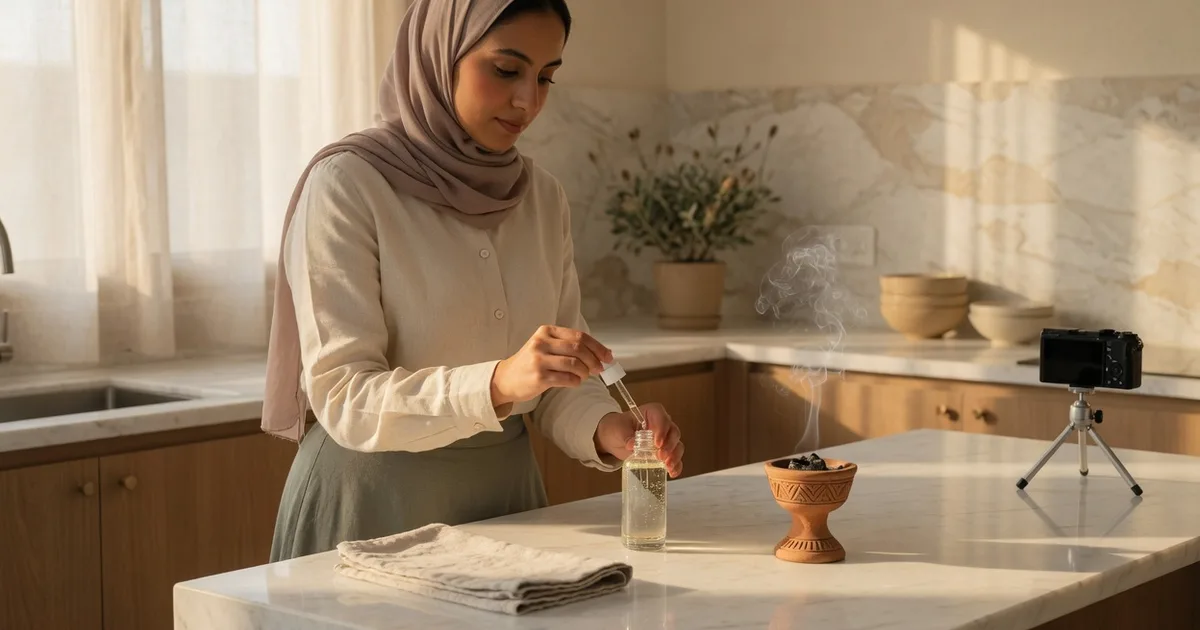
A practical guide to writing UGC hooks for Saudi product videos: six formulas, brief notes for the first three seconds, and a simple way to test two openings.
A UGC hook is the first one to three seconds of a product video — the spoken line, the opening visual, or both — that makes a Saudi shopper stop scrolling. If those seconds show a logo card, a slow lid twist, or a greeting with no product in frame, most people move on. The demo, the unboxing, and the testimonial never get watched.
Write the hook before you write the rest of the script. Put a familiar local problem on screen, start on proof the video can finish, or open in a setting a Saudi shopper recognises. Then tell the creator exactly what to say and what to show in second one. Below are six formulas you can reuse, hook notes you can paste into an order, and a simple way to test two openings.


What a UGC hook has to do in three seconds
A hook is not a slogan and it is not a brand introduction. It has one job: earn the next ten seconds.
On TikTok, Instagram Reels, and Snapchat, people decide with their thumb. They often see the first frames on mute. That means the opening visual has to make sense without sound, and the first spoken line has to make sense if they turn the sound on a moment later.
For a Saudi product video, a working hook usually does one of these things:
- Names a problem the shopper already has in this climate, this city, or this routine
- Shows the product being used, not the box sitting on a table
- Makes a specific claim the rest of the video can demonstrate
- Puts the product in a home, car, or daily setting that looks local
It does not need a large following behind it. A UGC creator is hired to make a ready-to-publish vertical video, not to rent an audience. The hook lives in the video, not in the creator's follower count.
Six UGC hook formulas for Saudi product videos
Use these as starting points. The lines below are hypothetical examples for a brief, not results from a real campaign.
| Formula | What the first seconds must do | Hypothetical opening |
|---|---|---|
| Problem in the room | Show the irritation before the product | “Every afternoon in Riyadh my makeup slides off before I reach the car.” |
| Proof first | Open on the outcome, then rewind to how | Close-up of fabric that does not cling; then the abaya on a body in motion |
| Showable outcome | Promise only what the video will demonstrate | “I wore this to a 2 p.m. meeting and the collar still looks clean.” |
| Local situation | Drop the viewer into a recognisable Saudi moment | Phone mounted on the dash before a King Fahd Road drive, one-handed setup |
| Spoken objection | Say the doubt the shopper is already thinking | “I thought another vitamin C would sting in Jeddah humidity. I still applied it.” |
| Product interrupt | Cut the greeting; start mid-use | Hands already pouring dates into a lunchbox; first line comes after the action |
Pick one formula per video. If you ask the creator to do all six in one take, the opening becomes a montage and the hook disappears.
How to choose a formula
- New product, low awareness: problem in the room, or product interrupt
- Shoppers who already know the category: spoken objection, or proof first
- Product that looks similar to competitors: local situation, or a showable outcome
Keep the spoken line under about twelve words. If you cannot say it in one breath, it is a paragraph, not a hook.
Change the hook when the video type changes
The same product needs a different first second depending on the job of the video.
- Unboxing: the hook is the expectation, not the cardboard. Open on the item people care about, or on the question the box is about to answer. Do not open on a courier bag.
- Demo: the hook is the problem in use. Start mid-action — applying, clipping, pouring, wiping — then name what is going wrong or what just got easier.
- Testimonial: the hook is a specific opinion, not “I love this brand.” Open on the detail a buyer would repeat to a friend.
If you are still deciding which of those to order first, start with the video that matches the shopper’s next question, not the format that is easiest to film. See which UGC video to order first — unboxing, demo, or testimonial.
Choose Arabic, English, or mixed for the first line
Write the hook in the language your customer uses when they talk about the problem, not the language your brand uses on the website.
- Arabic first if the store’s comments, WhatsApp questions, and reviews are mostly Arabic
- English first if the product is bought in English and the customer already searches that way
- Mixed only when it sounds like a real person in your city, not like a translated slogan
A common pattern that still sounds natural: Arabic for the problem, the product name in English if that is how people say it. Record the line out loud. If it sounds like a press release, rewrite it.
The creator should hear the exact first sentence. “Make it catchy” is not a hook.
Hook notes you can paste into the order
You do not need a full script to get a usable opening. You do need the first second to be specified. Paste something this tight:
Hook notes
Product and size in frame:
Who this video is for (one sentence):
Problem in one line:
Visual at 0:00 (no logo, no greeting):
Spoken line (Arabic / English / mixed):
Words or claims we will not use:
What the next 10 seconds must prove:
Second hook, only if ordered as an extra:
Give one spoken line, not three options in the same take. If you want a second opening from the same creator — a different first line or a different first shot — that is a separate extra. On PushBrands it appears as Additional Hook, priced on its own and shown before you order. Use it when you plan to test two openings, not when you are still unsure what the video is about. For when extras are worth adding, see when to add extra services to a UGC order.
A hypothetical two-hook test
This is a worked example, not a PushBrands case study.
A Riyadh skincare store is shooting one vertical demo for a gel moisturiser. The brand writes two hooks for the same product, same creator, same usage shot:
- Problem: “By 3 p.m. my face feels tight and shiny at the same time.”
- Objection: “I stopped using gel because it never lasted after AC all day.”
The rest of the video stays identical: apply, wait, show skin in office light, close on the pack. The brand runs each opening as a separate file. It keeps the version that holds attention into the application shot, then iterates the first line again if needed.
Do not judge a hook by comments on the creator’s personal page. Judge it by whether strangers who do not know the brand still watch past second three.
What this test does not do: it does not predict sales, view counts, or a winning ROAS. It only tells you which opening earns more of the video.
Openings that waste the first three seconds
- A logo or pack shot with no hands and no context
- “Hi everyone” or “السلام عليكم” before the product or the problem
- A slow unbox that hides the item until second eight
- A claim the video never shows (“this will change your skin in a week”)
- A hook written for an influencer intro: name, follower proof, then the product
- Three hooks cut into the first five seconds so none of them land
- English copy that was translated line by line from a US ad and does not sound spoken
If the delivered video has a weak opening but a strong middle, do not accept it and “fix it in captions.” Ask for a recut that starts on the specified visual and line. The first three seconds are the deliverable, not decoration.
What to do next
- Choose one live product and one video job: unboxing, demo, or testimonial.
- Write two hook lines with two different formulas from the table.
- Paste the hook notes into the order so the creator is not guessing.
- When the video comes back, watch the first three seconds on mute, then with sound, on your phone.
- If the opening is generic, request a recut or order an additional hook instead of reshooting the whole video.
When you are ready to brief a creator, you can browse Saudi creators on PushBrands by product category, open previous work, and order a vertical video at the price the creator set. Extra services such as an additional hook are shown before you pay. Payment stays held until you accept the delivered video. UGC services on PushBrands start from SAR 150; each creator sets their own base price.
FAQ
How long should a UGC hook be?
Plan for one to three seconds of purpose, not a five-second intro. The visual should be clear at frame one. The spoken line should fit in a single breath.
Do I need an influencer for a stronger hook?
No. An influencer is paid mainly for access to an audience. A UGC creator is paid to make a video you can publish. Follower count does not write the first sentence, and there is no follower minimum for this kind of work.
Can one creator deliver two different hooks?
Yes, if you ask for that as a defined extra and you write both openings in the order. Do not expect two hooks if you only described “something attention-grabbing.”
Should the hook mention price or a discount?
Only if the rest of the video is actually about the offer, and only if the price will still be true when you publish. A product-use hook ages better than a promotional hook.
- ugc hooks
- product videos
- saudi ecommerce
- short-form video
- tiktok reels